

VIII INTERNATIONAL SCIENTIFIC CONFERENCE OF ECONOMICS AND
MANAGEMENT RESEARCHERS (ISCEMR VIII)
AUTHOR GUIDELINES
Original research papers that have not been previously published or reported elsewhere should be sent to the conference. The submitted reports will be evaluated by the scientific committee of the conference through a closed evaluation system. Research papers that do not comply with the rules of writing and the requirements of the conference will not be accepted.
Research papers in 4 languages (Azerbaijani, Turkish, English and Russian) are accepted for the conference. The research papers should be prepared according to the following sections:
- Title of the topic;
- Author information;
- Abstract, keywords, and JEL code;
- Introduction;
- Literature review;
- Methodology and variables;
- Preliminary results and discussion;
- Conclusion and recommendations;
- References.
- For review-type papers, the sections “literature review,” “methodology and variables,” and “preliminary results and discussion” may be combined and presented under a single general heading (for example, “main body”).
- The title of the paper should consist of no more than 10–14 words and be written in Times New Roman, 14 pt, with only the first letters of words capitalized, in bold, and centered.
- Author information – first and last name, academic degree and title, current level of study (master’s student, doctoral student), and university e-mail address – should be written in Times New Roman, 12 pt, in bold, and centered, directly below the paper title.
- The abstract should be written in the language of the paper and consist of 150–200 words. It should reflect the relevance of the topic, the purpose, object, and time period covered by the research, the methods and variables used, the main results obtained, and recommendations. In addition to the abstract in the language of the paper, an English translation must also be provided. If the paper is not prepared in Azerbaijani, an Azerbaijani translation of the abstract must also be included. After the abstract, keywords (4–8 words) should be provided in italics, starting from a new paragraph. In the paragraph following the keywords, the relevant JEL codes (http://www.aeaweb.org/jel/jel_class_system.php corresponding to the research field should be indicated. The abstract and keywords should be written in Times New Roman, 10 pt, with single line spacing and justified alignment.
- The Introduction section should indicate the relevance of the topic and the level of prior research, the object, subject, and purpose of the study, the information base and methods used, research limitations, and the expected theoretical and practical significance of the results. The length of the introduction may be 1–1.5 pages.
- In the Literature Review section, the results of theoretical and empirical studies conducted in the relevant field should be summarized and grouped, scientific and practical “gaps” should be identified, and the linkage between the obtained arguments and the purpose of the paper should be demonstrated.
- The Methodology and Variables section should provide a brief description of the selected research method and an explanation of the indicators to be analyzed.
- In the Preliminary Results and Discussion section, the results obtained through the application of the method should be presented, and these results should be compared with the findings highlighted in the literature review.
- In the Conclusion and Recommendations section, the generalized results of the research should be presented, recommendations for future studies on the topic should be provided, and the theoretical and practical significance of the results should be noted.
- The References section should be organized by grouping sources according to the language in which they are written and numbering them sequentially in alphabetical order. At least 15 sources must be included in the reference list. For works available in open internet resources, it is recommended to include the relevant links. Sources that are not cited in the text should not be included in the reference list. The main part of the references should consist of works published within the last five years. Examples of how sources should be listed in the references section:
Fukuda, S. (2025). Short-run and long-run consequences of unconventional monetary policy in Japan. Journal of the Japanese and International Economies, 77, 101375. https://doi.org/10.1016/j.jjie.2025.101375
Federal Reserve Bank of St. Louis. (n.d.). Federal Reserve Economic Data. (Brent oil prices were retrieved from Federal Reserve Economic Data). https://fred.stlouisfed.org/
Mishkin, F. S. (1996). The channels of monetary transmission: Lessons for monetary policy. NBER Working Paper No. 5464. https://doi.org/10.3386/w5464
After the References section, a plagiarism report for the paper (generated automatically by the relevant plagiarism detection software) must be included. The overall similarity index of the paper must not exceed 25%. If the similarity level exceeds this threshold and sections with similarity lacking proper citation are identified, the paper will be returned and will not be reconsidered.
- The research paper will be prepared in .doc, .docx ending in MS Office Word file format. The page size should be 2.5 cm on the left edge, 1.5 cm on the right edge, and 2.0 cm on the bottom and top.
- The length of the research paper (excluding the reference list, spaces, tables, schemes, graphs, figures, and the plagiarism report) must be no less than 7,000 characters and no more than 15,000 characters.
- The main headings of the paper should be written in Times New Roman, 12 pt, with the first letters of words capitalized, in bold, and left-aligned. Subheadings should be written in Times New Roman, 12 pt, with only the first letter of the heading capitalized, in bold, and left-aligned.
- The internal text, titles, and captions of tables, figures, schemes, and graphs should be written in Times New Roman, 10 pt, with single line spacing (1.0). Their titles should be left-aligned, written in bold, with only the first letter capitalized, using a 10 pt font.
- Author’s information (name, surname, university, and e-mail) is written in Times New Roman 12 font, Bold, Center format under the title of the research paper.
- Summaries are written in Times New Roman 10 font with minimum 150 and maximum 200 words, line spacing 1.15, justified format.
- The text of the papers should be written in Times New Roman, 12 pt, with 1.15 line spacing, 6 pt spacing before and after paragraphs, and one blank line left after each heading.
- References must be in APA (American Psychological Association) style. More details: http://www.apastyle.org/learn/tutorials/basics-tutorial.aspx. References should be clearly cited in the body of the text, e.g. (Smith, 2006) or (Smith, 2006, p.45), if an exact quotation is being used. At the end of the paper the author(s) should present full References in the alphabetical order as follows:
- books: Author, A. A. (2012). This is a book title. Abingdon: Routledge.
- journals: Author, A. A. (2011). Title of article. Title of Journal, 5(1), 123–231. doi:xx.xxxxxxxxxx.
- Proceedings: Author, A. A. (2017, March). Title of paper. Paper presented at the meeting of Organization Name, Location.
- Internet sources: Author, A. A. (2017). Title of work. Retrieved month day, year, from source. if no Author or date www.worldbank.org. Retrieved August 8, 2017, from http://
- The references are numbered sequentially in the Times New Roman 12 font, before and after 0 spaces.
REFERENCES (FOR EXAMPLE)
- Berndt, T. J. (2002). Friendship quality and social development. Current Directions in Psychological Science, 11, 7-10.
- Wegener, D. T. and Petty, R. E. (1994). Mood management across affective states: The hedonic contingency hypothesis. Journal of Personality and Social Psychology, 66, 1034-1048.
- American Psychological Association. (2003).
- Berndt, T. J. (1999). Friends’ influence on students’ adjustment to school. Educational Psychologist, 34, 15-28.
- Berndt, T. J. (1981a). Age changes and changes over time in prosocial intentions and behavior between friends. Developmental Psychology, 17, 408-416.
- Berndt, T. J. (1981b). Effects of friendship on prosocial intentions and behavior. Child Development, 52, 636-643.
- Harlow, H. F. (1983). Fundamentals for preparing psychology journal articles. Journal of Comparative and Physiological Psychology, 55, 893-896.
Table 1.Comparison of Public Inflation Expectations and Actual Inflation Rates (2020-2023)
| Year | Public Inflation Expectations (%) | Actual Inflation Rate (%) |
| 2020 | 5.0 | 4.8 |
| 2021 | 6.2 | 6.5 |
| 2022 | 7.0 | 7.2 |
| 2023 | 6.5 | 6.0 |
Source: Zulfigarov, F., & Neuenkirch, M. (2020). The impact of oil prices on selected macroeconomic indicators of Azerbaijan. Economic Systems, 44(4), 100814.
Graph 1. Inflation rate in Azerbaijan in 2022-2023 (by %).
| TARGET BAND (4±2%) |
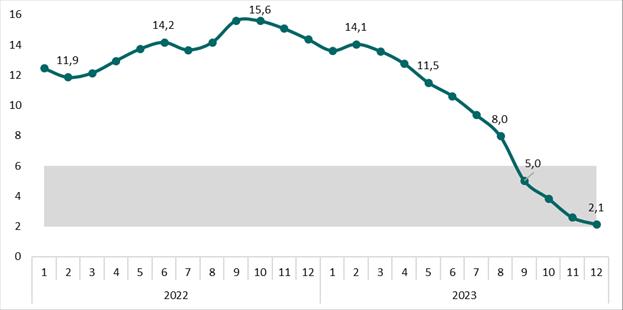
Source: The State Statistical Committee of the Republic of Azerbaijan, www.stat.gov.az (15.02.2024)